
Awaiting regulatory approvals for its foray into financial services sector, Mukesh Ambani-led Reliance Industries has acquired shares in giants like HDFC, ICICI Bank and Axis Bank as part of long-term 'investments'.
Axis Bank's acquisition of Citibank's consumer finance business for Rs 12,325 crore - the second biggest deal in the Indian banking sector - is seen as a good deal at a good price. The acquisition enables Axis Bank to close the gap with competition in some key segments such as credit cards. At the same time, there are some key issues that are crucial for the deal's success, apart from the fact that it will take some time for Axis to reap the full harvest of its investment.

The charges would apply to savings as well as salary accounts

From the Sensex pack, Jio Financial Services fell the most by 4.99 per cent. Reliance Industries, Power Grid, Larsen & Toubro, JSW Steel, HCL Technologies, NTPC, Tata Steel, Wipro, Tata Consultancy Services and HDFC Bank also declined. IndusInd Bank, Infosys, UltraTech Cement, ICICI Bank, Nestle and Axis Bank were among the gainers.

Equity benchmark indices Sensex and Nifty rebounded sharply by nearly 1 per cent on Monday, driven by strong buying in power, banking, and financial stocks.

Maruti, Axis Bank, HDFC, ICICI Bank and Bajaj Finance also finished with gains. NSE Nifty rallied 203.65 points to 11,095.25.

Among the 30 Sensex companies, JSW Steel, Tata Steel, Axis Bank, Reliance Industries, ICICI Bank, Hindustan Unilever, Kotak Mahindra Bank and Asian Paints were among the biggest gainers. In contrast, Mahindra & Mahindra, Sun Pharma, NTPC, Wipro, State Bank of India and Power Grid were among the laggards.

Among the Sensex firms, Power Grid, HDFC Bank, Kotak Mahindra Bank, Reliance Industries, NTPC, State Bank of India, Tata Steel and Bharti Airtel were the major gainers. Bajaj Finance, Axis Bank, HCL Tech and Mahindra & Mahindra were among the major laggards.
Indian stock markets saw a significant rebound, with the Sensex jumping nearly 790 points, primarily fuelled by strong buying interest in telecom, pharma, and private banking shares, despite a volatile trading session and a weakening rupee.

Re-rating of Axis Bank's stock may continue in the near-future, believe analysts, as the risk-reward on the stock remains favourable amid healthy financials. The bullish stance comes after the Mumbai-based lender delivered a strong outperformance in the March quarter of fiscal year 2023-24 (Q4FY24) on core pre-provision profit and net profit, with improving asset quality. Axis Bank's net interest margin (NIM) expanded, against expectations, even in a tough market.
With the merger between HDFC Bank and HDFC Ltd complete, analysts said the next key monitorable for the Street would be successful resolution of merger-related hiccups, including employee-related churn and roll out of complete banking services across branches. At the bourses, they expect the stock to perform in-line with the benchmark indices in the near-term. "There's usually an initial period of consolidation after a merger as the entities work towards integration.

Indian benchmark indices Sensex and Nifty continued their upward trend for a second consecutive day, with the Sensex gaining over 800 points, driven by strong performances from heavyweights like Reliance Industries, ICICI Bank, and HDFC Bank, alongside positive cues from easing crude oil prices and robust IT sector earnings.

Three officials from leading private banks have been arrested for their alleged involvement in a Rs 2,500-crore cyber fraud racket in Gujarat's Rajkot district, bringing the total number of arrests in the case to 20.

Three officials from leading private banks have been arrested for their alleged involvement in a Rs 2,500-crore cyber fraud in Gujarat's Rajkot district, bringing the total number of arrests in the case to 20, according to police reports.

M&M was the biggest gainer in the Sensex chart, rising 6.51 per cent, followed by NTPC, PowerGrid, SBI, HDFC Bank, Asian Paints and Wipro. In contrast, Axis Bank, ITC, HUL, Nestle India and Sun Pharma were among the laggards.

Sharma would be 60 in November 2018, and would have completed 10 years as Axis Bank's CEO the following year in June.
Shares of HDFC Bank will witness massive inflows totalling $600 million from passive trackers this week, predict analysts. This influx is attributed to the rebalancing activities in the S&B BSE Sensex and the Financial Times Stock Exchange (FTSE) indices. The Sensex is set for its quarterly rebalancing act on September 15 (date of adjustment), resulting in inflows of $102 million (approximately Rs 850 crore).
HDFC Bank has ensured that no bank will be able to match them in the near future without bleeding on margins.

IndusInd Bank was the biggest gainer in the Sensex pack, rising 3.25 per cent, followed by Tech Mahindra, Wipro, Bharti Airtel, HCL Technologies, Axis Bank, HDFC Bank, RIL, TCS, L&T and Infosys. State Bank of India, NTPC, Maruti, Bajaj Finserv, Tata Motors and Power Grid were among the laggards, slipping up to 2.94 per cent.

Bharat Electronics, Bharti Airtel, HDFC Bank, Kotak Mahindra Bank, Titan and Eternal were also among the laggards from the Sensex pack. However, Bajaj Finance, Tata Steel, ICICI Bank, HCL Tech and Infosys were among the gainers.

Banking sector has witnessed healthy growth in advances in the third quarter of financial year 2026 (Q3FY26) against the same period last year, as the full impact of goods and service tax (GST) rate cuts drove growth. Most of the lenders saw their credit growth outpace the deposit growth in the quarter.

Banks and NBFCs are launching festival offers, including lower loan rates, cashback, EMI schemes and GST-linked benefits to tap rising demand ahead of Diwali

Motorola has expanded its G-series lineup in India with the launch of the Moto G77 Power, a smartphone designed for users who prioritise battery life and reliable everyday performance.
Shares of most European banks are down significantly.

Puri gave up the comforts of Citibank to set up a new-age bank from a rat-infested room in the Kamala Mills Compound in Worli, Mumbai and build a marquee brand. A look at his 26-year stint as HDFC Bank's boss.
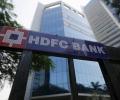
The country's most valuable lender HDFC Bank can perhaps no longer claim to be a favourite of foreign portfolio investors (FPIs). Two data indicators, both somewhat interconnected, point to this - the diminishing premium of HDFC Bank's American depositary receipts (ADRs) compared to local shares, and the ample investment opportunities available to FPIs in the domestic market. The ADR premium has shrunk to below 5 per cent, down from over 30 per cent in March 2021, and even lower than recent levels.

HDFC Bank becomes first Indian lender to develop mobile banking app for Apple's latest offering in India.
While HDFC Bank has vowed to recoup its lost market share in the credit card segment in three to four quarters by aggressively sourcing new cards, brokerages believe it is a little hard to come by, given how competitive the landscape has become, with other players in the market becoming equally aggressive to gain market share. Kotak Institutional Equities in its report on Monday said, "We would like to believe that the recovery in market share is likely to be gradual, if any. "All the key players, including Axis Bank, are now willing to expand their credit card portfolios as they have tested quite well against Covid-19."

Kaizad Bharucha, executive director of HDFC Bank, emerged the highest earning banker for 2021-22 (FY22). This was revealed in a remuneration assessment of the country's top bankers, according to annual reports. Bharucha, who oversees wholesale banking at HDFC Bank, received Rs 10.64 crore remuneration in FY22, mainly due to Rs 4.46 crore as performance bonus. Although earned between 2017-18 and 2020-21 (FY21), the bonus payout was partly paid in FY22.
The main losers on the Sensex are Axis Bank, Tata Motors, Wipro, SBI and HDFC Bank.

Among the Sensex firms, IndusInd Bank was the biggest loser and fell 6.13 per cent, followed by SBI (3.99 pc), Hindustan Unilever (3.82 pc), Axis Bank (3.41 pc) and HDFC Bank (3.23 pc). In contrast, Sun Pharma, Bharti Airtel, ICICI Bank and PowerGrid defied the trend and closed with gains of up to 3.67 per cent. TCS and Bajaj Finserve were the other gainers.

Indian benchmark indices Sensex and Nifty closed flat, paring early gains due to renewed hostilities between the US and Iran, which unsettled investor sentiment and led to profit booking in metal, oil & gas, and telecom shares.

Benchmark equity indices Sensex and Nifty extended their gains for the third straight session on Wednesday, driven by last-hour buying in bank, metal, and FMCG shares.

Indian stock market benchmark indices Sensex and Nifty rebounded in early trade, driven by a decline in crude oil prices, supportive global cues, fresh foreign fund inflows, and buying in blue-chips like Reliance Industries and HDFC Bank. Track Sensex, Nifty movement on June 22, 2026.

Banking operations at public sector banks across the country were impacted on Tuesday as the United Forum of Bank Unions (UFBU) went on nationwide strike demanding the immediate implementation of a five-day work week.
US bank Citigroup on Wednesday announced the sale of its Indian consumer banking businesses, including credit cards, retail banking, wealth management and consumer loans, to private lender Axis Bank for Rs 12,325 crore, as part of its plans to exit retail operations in 13 markets.
Indian equity benchmark indices Sensex and Nifty rallied in early trade, driven by reports of a second round of talks between the US and Iran, which are fostering hopes for a resolution to the West Asia conflict, coupled with Brent crude oil prices trading below the USD 100 per barrel mark.

Sectoral funds, focused exclusively on public sector banks (PSBs), have delivered the strongest returns among domestic mutual fund (MF) categories over the past six months. However, active banking funds have significantly lagged because of their heavy tilt towards private lenders.
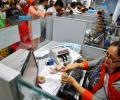
Indian bank credit expanded by 16.08 per cent year-on-year in FY26, marking its fastest pace since FY24, while deposits grew by 13.47 per cent, according to RBI data. Experts caution that year-end figures may be inflated due to reporting date changes, but acknowledge strong momentum in corporate, MSME, and retail segments.
Weakness in HDFC Bank's net interest margin (NIM) might have bottomed out in the July-September quarter (Q2-FY24), analysts said on Tuesday, as most of the merger-related one-time adjustments have been done. The bank, they believe, should be able to grow from here on, allowing the stock to reverse its underperformance. "The weak NIM print was not unexpected given the merger and regulatory impact caused by the incremental cash reserve ratio (ICRR; 5-10 bps for the quarter).
